
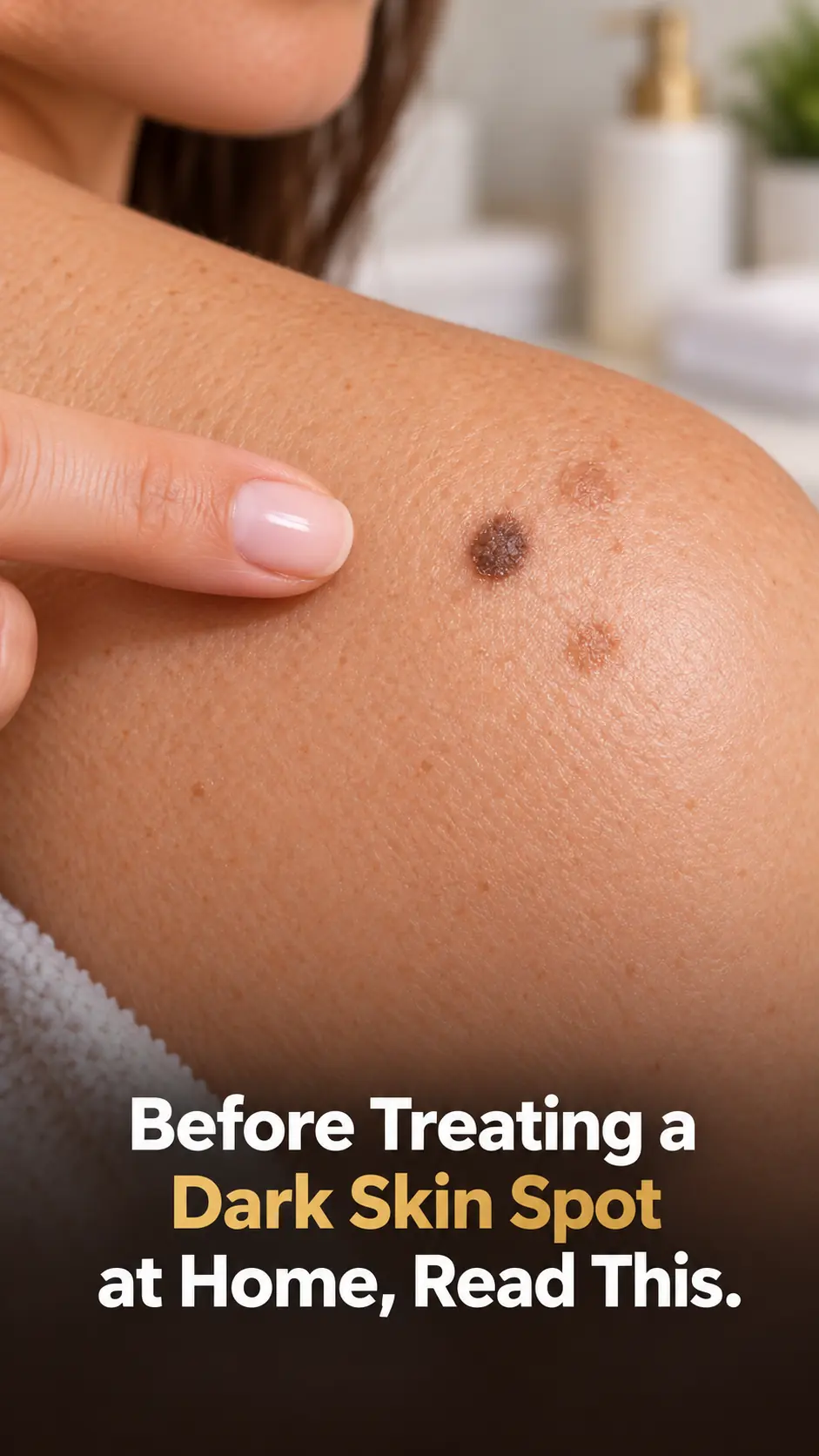
Before Trying to Remove a Mole or Raised Bump at Home, Read This
Meta description: Flat moles, raised bumps, and textured facial spots may look harmless, but home removal methods can cause burns, scars, and delayed skin cancer diagnosis. Learn what to do instead.
A small spot on the cheek can become surprisingly difficult to ignore. It may be flat and brown, slightly raised, rough to the touch, or simply different from the surrounding skin.
Because these marks are so visible, it is easy to understand why someone might search for a quick home remedy. Social media posts often suggest applying a household ingredient, covering the spot overnight, or repeating the treatment until the unwanted growth disappears.
Unfortunately, treating an unidentified facial lesion at home is not as simple—or as safe—as these posts suggest.
A “mole,” “bump,” or “textured spot” is only a description of how something looks. It is not a diagnosis. Several completely different skin conditions can have a similar appearance, and each one may require a different approach.
Not Every Facial Spot Is a Mole
A dark or raised area on the cheek could be:
A common mole, also called a nevus
A skin tag
A wart
A seborrheic keratosis
A sun spot or area of hyperpigmentation
A clogged pore or small cyst
An actinic keratosis caused by sun damage
Basal cell or squamous cell skin cancer
Melanoma
Most facial spots are benign, but appearance alone does not always provide a reliable answer. Even experienced clinicians may use a dermatoscope or perform a biopsy when a lesion has uncertain features.
This is why applying the same “one-ingredient solution” to every mole, bump, and rough patch is risky.
Can a Home Remedy Really Remove a Mole?
There is no scientifically established kitchen remedy that can safely identify and remove every type of mole or facial growth.
Popular online methods often involve acidic, irritating, or caustic substances. These ingredients may damage the surface of the skin and create the appearance that the spot is shrinking. In reality, they are causing a chemical injury rather than performing a controlled medical removal.
The treatment may destroy only part of the lesion while leaving deeper cells behind. The spot can return, become inflamed, or heal with permanent discoloration.
More importantly, damaging the lesion may make it harder for a doctor to evaluate. If the growth contains cancerous or precancerous cells, attempting to remove it at home can delay diagnosis and appropriate treatment.
Why Facial Skin Requires Extra Care
The skin on the face is highly visible and contains many small nerves and blood vessels. An uncontrolled burn or wound on the cheek can lead to:
Permanent scarring
Dark or light patches
Infection
Prolonged redness
Bleeding
Pain and swelling
Changes in facial contour
Incomplete removal and regrowth
People with deeper skin tones may have a particularly high risk of post-inflammatory hyperpigmentation or raised scars after skin injury.
The fact that an ingredient is described as “natural” does not make it harmless. Acids from food, concentrated essential oils, plant extracts, and corrosive pastes can all injure living tissue.
Methods You Should Avoid
Do not try to remove an unidentified mole or facial bump by:
Applying apple cider vinegar, lemon juice, garlic, iodine, or strong essential oils
Using wart-removal acid on a mole
Applying so-called black salve
Cutting or shaving it with a razor
Burning it with a heated object
Tying thread or dental floss around it
Puncturing, squeezing, or scraping it
Using an at-home freezing product unless a clinician has confirmed that the product is appropriate for that exact lesion
These approaches do not allow the removed tissue to be examined under a microscope. They can also cause uncontrolled damage beyond the border of the original spot.
Black salve is especially dangerous. Products marketed under this name may contain corrosive ingredients that destroy both abnormal and healthy tissue. They can create deep wounds and severe scars without reliably eliminating cancer cells.
Check the ABCDE Warning Signs
A pigmented spot should be evaluated promptly if it demonstrates any of the ABCDE features associated with melanoma:
A — Asymmetry
One half of the spot does not resemble the other half.
B — Border
The edges appear irregular, blurred, scalloped, or poorly defined.
C — Color
The spot contains several colors or uneven shades, including brown, black, red, white, gray, or blue.
D — Diameter
Melanomas are often larger than approximately 6 millimeters when diagnosed, but they can also be smaller. Size alone cannot rule out melanoma.
E — Evolving
The spot changes in size, shape, color, elevation, texture, or symptoms.
The “ugly duckling” sign is also important. A growth that looks noticeably different from your other moles deserves professional attention, even if it does not satisfy every ABCDE criterion.
Other Reasons to See a Dermatologist
Arrange an examination if a lesion:
Appears suddenly or grows rapidly
Bleeds without a clear injury
Repeatedly forms a crust or scab
Does not heal
Becomes painful, itchy, or tender
Changes from flat to raised
Develops an open sore
Looks shiny, pearly, or translucent
Has visible blood vessels
Returns after being removed
Is located where it is repeatedly cut or irritated
Causes concern for any reason
Do not wait for every warning sign to appear. Early skin cancers can be subtle, while some benign spots can look unusual. A dermatologist is best equipped to distinguish between them.
What Happens During a Professional Examination?
A dermatologist will usually begin by asking how long the spot has been present and whether it has changed. The doctor may then examine it with a dermatoscope, a magnifying device that reveals structures beneath the skin’s surface.
If the lesion appears suspicious, part or all of it may be removed for a biopsy. A laboratory then examines the tissue under a microscope.
This step matters because it provides a diagnosis—not merely a cosmetic result.
If the growth is benign but bothersome, the doctor can discuss whether removal is worthwhile and which technique is likely to produce the best cosmetic outcome.
Safe Professional Removal Options
Treatment depends on what the lesion actually is. Options may include:
Shave removal
A clinician carefully removes a raised lesion close to the skin’s surface. This technique may be appropriate for certain benign growths and some types of biopsy.
Surgical excision
The entire lesion is removed with a margin of surrounding tissue, and the area is closed with stitches. Excision may be recommended for suspicious or deeper growths.
Punch biopsy
A circular instrument removes a small column of tissue for laboratory examination. The opening may require one or more stitches.
Cryotherapy
Liquid nitrogen may be used for selected warts, actinic keratoses, or seborrheic keratoses. It is not a universal treatment for pigmented moles.
Curettage or electrosurgery
Certain benign or superficial lesions can be scraped and treated with electrical energy by a trained professional.
Laser treatment
Lasers may help with carefully diagnosed vascular spots or pigmentation problems. They are generally not the first choice for an undiagnosed pigmented mole because the tissue cannot be submitted for complete pathological examination.
Every procedure carries some risk of scarring or discoloration, but professional treatment allows the depth and location of the injury to be controlled.
What You Can Safely Do at Home
Although you should not attempt to destroy the growth, you can take several useful steps before your appointment.
First, photograph the area in clear natural light. Place a ruler beside it so you can compare its size over time. Record the date and note any symptoms, such as itching or bleeding.
Avoid picking, scratching, or repeatedly touching the spot. If cosmetics or shaving products irritate it, keep the routine gentle until it has been examined.
Protect the area from ultraviolet radiation by using a broad-spectrum, water-resistant sunscreen with an SPF of at least 30. Wear a hat when spending extended time outdoors and reapply sunscreen as directed.
These measures will not remove a mole, but they can reduce irritation, help you document changes, and protect the surrounding skin.
What About Rough Texture and Uneven Tone?
Not every cosmetic concern requires removal. If a dermatologist confirms that the area is ordinary dry skin, acne-related texture, or harmless pigmentation, a gradual skincare routine may improve its appearance.
Depending on the diagnosis, that routine might include:
A gentle fragrance-free cleanser
A non-comedogenic moisturizer
Daily broad-spectrum sunscreen
Niacinamide
Azelaic acid
A carefully introduced retinoid
Professionally supervised chemical exfoliation
Do not apply active skincare ingredients directly to a mole in an effort to make it disappear. These products may improve the surrounding complexion, but they are not substitutes for diagnosis or medical removal.
The Bottom Line
A spot on the cheek may seem like a small cosmetic problem, but removing it without knowing what it is can create a much larger one.
Household acids and other viral remedies may burn the surface of the skin, yet they cannot confirm whether the lesion is benign or ensure that it has been completely removed. The possible result includes infection, permanent scarring, pigment changes, and delayed detection of skin cancer.
The safest “one method” is not a substance left on the cheek overnight. It is having the spot correctly identified before deciding how—or whether—it should be removed.
If the lesion is benign, a dermatologist can recommend an appropriate cosmetic treatment. If it is suspicious, early diagnosis could be far more important than the cosmetic concern that first brought it to your attention.
Medical disclaimer: This article is for general educational purposes only and is not a substitute for examination, diagnosis, or treatment by a qualified healthcare professional. Do not attempt to remove an unidentified mole or skin growth at home. Seek prompt medical care for any new, changing, bleeding, painful, or non-healing lesion.




Comments